
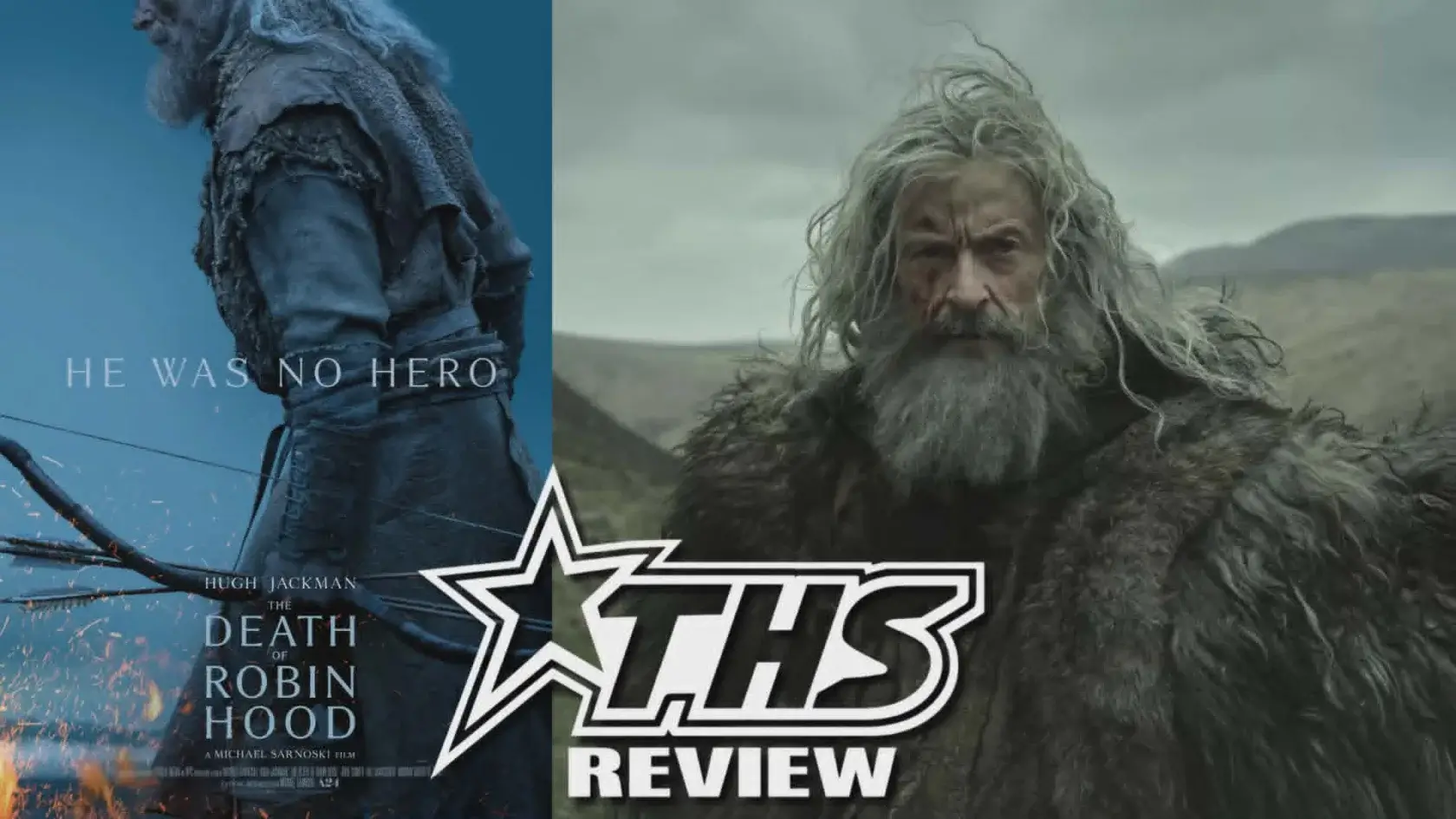
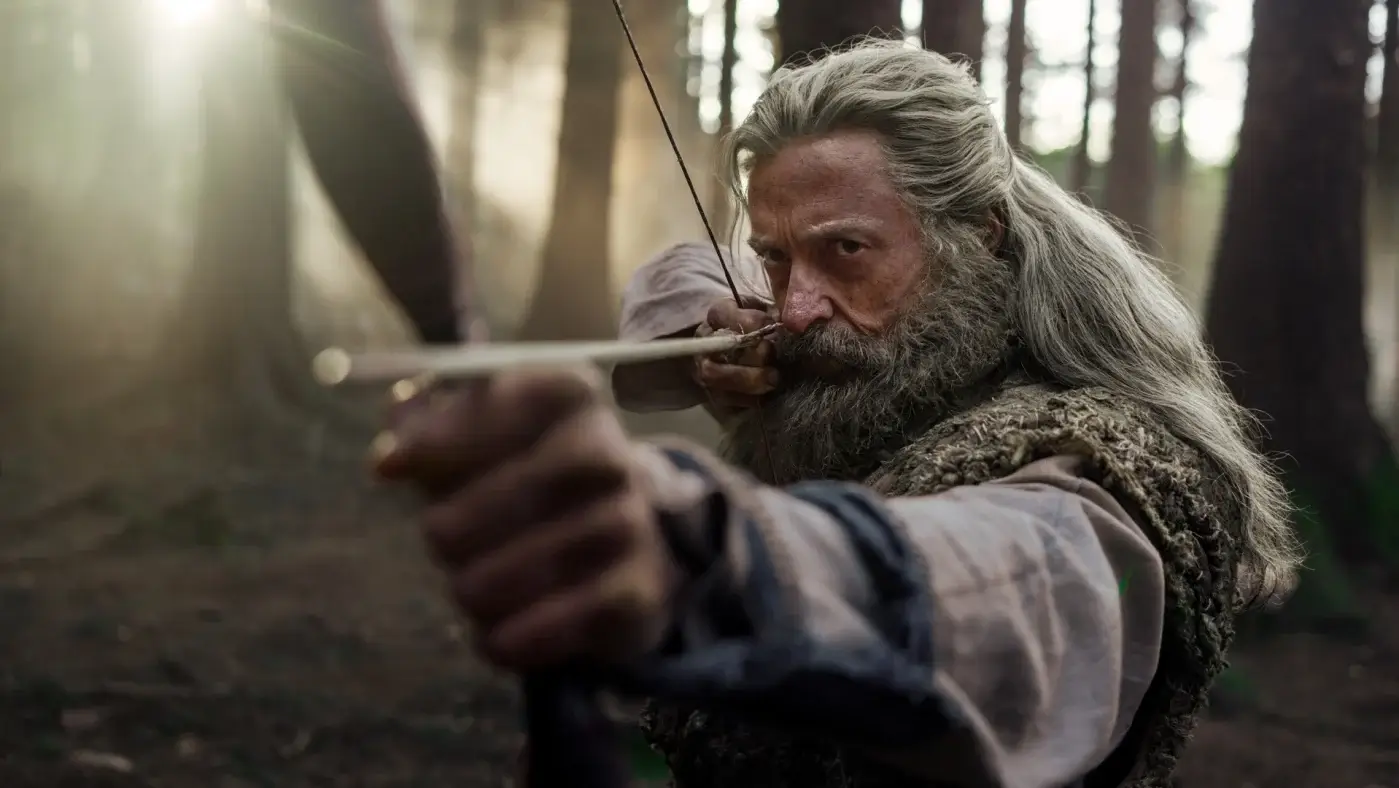
The Death of… Heroism?
The Outlaw Robin Hood (Hugh Jackman) is old, haggard, and haunted by the actions of his brutal past. He fends off would-be assassins when his old friend Edward, formerly Little John (Bill Skarsgård), shows up in need of help in the second life he’s formed outside of their violent ways.
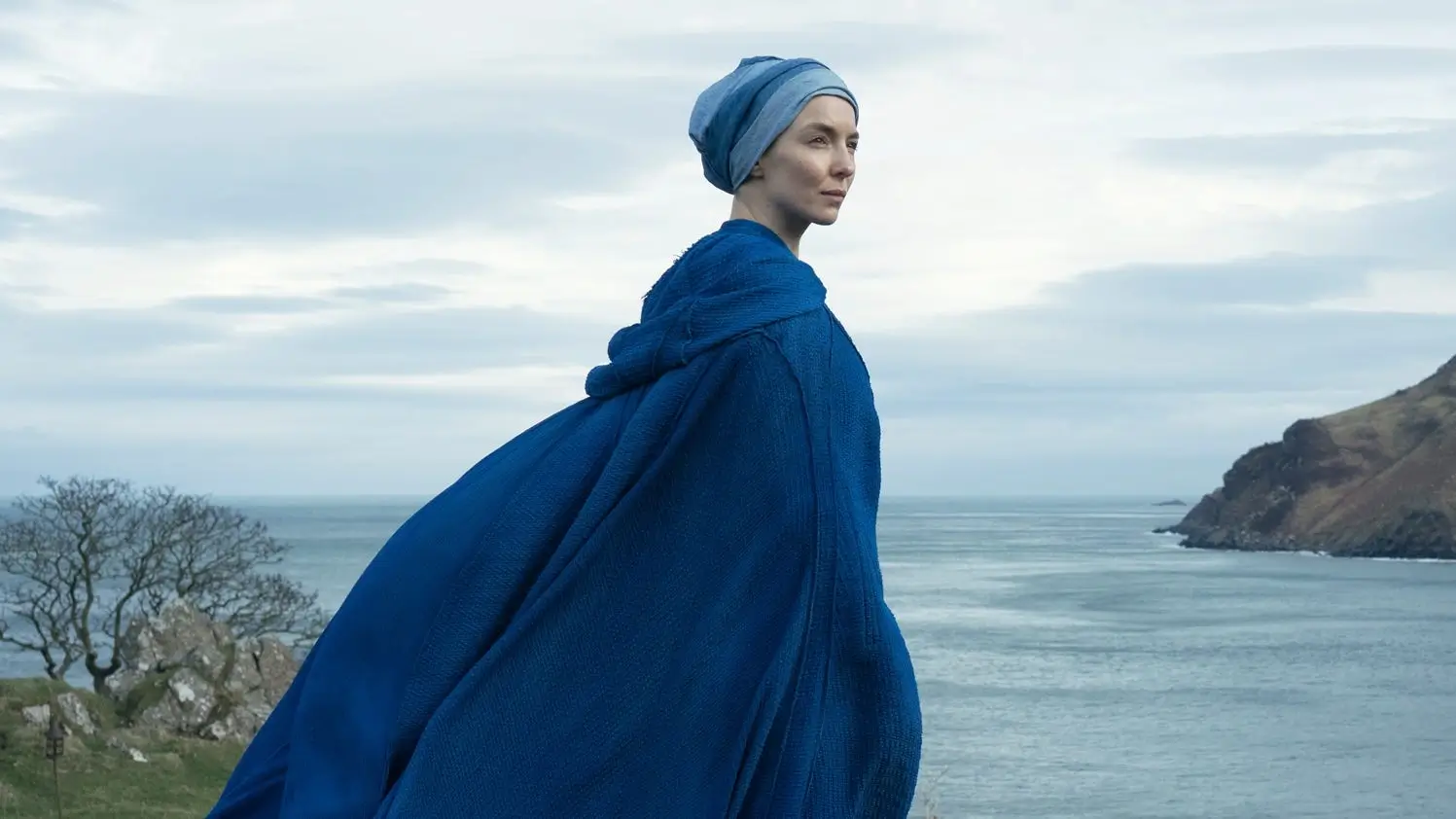
Things go sideways when they return to Edward’s farm, and Robin narrowly avoids dying in battle. Edward and his daughter take Robin to a priory where a doting sister (Jodie Comer) nurses him back to health, despite his desire to die.
Everything that made Michael Sarnoski’s memorable slow-burn debut Pig so striking is present again here, as the bearded, miserable loner played by a screen icon wrestles with his past.
The power this time is in the context, the myth itself, the underpinning philosophical questions that bear harsh relevance to today. This is decidedly not your Grandad’s Robin Hood, but to what end?
The Power of Myth
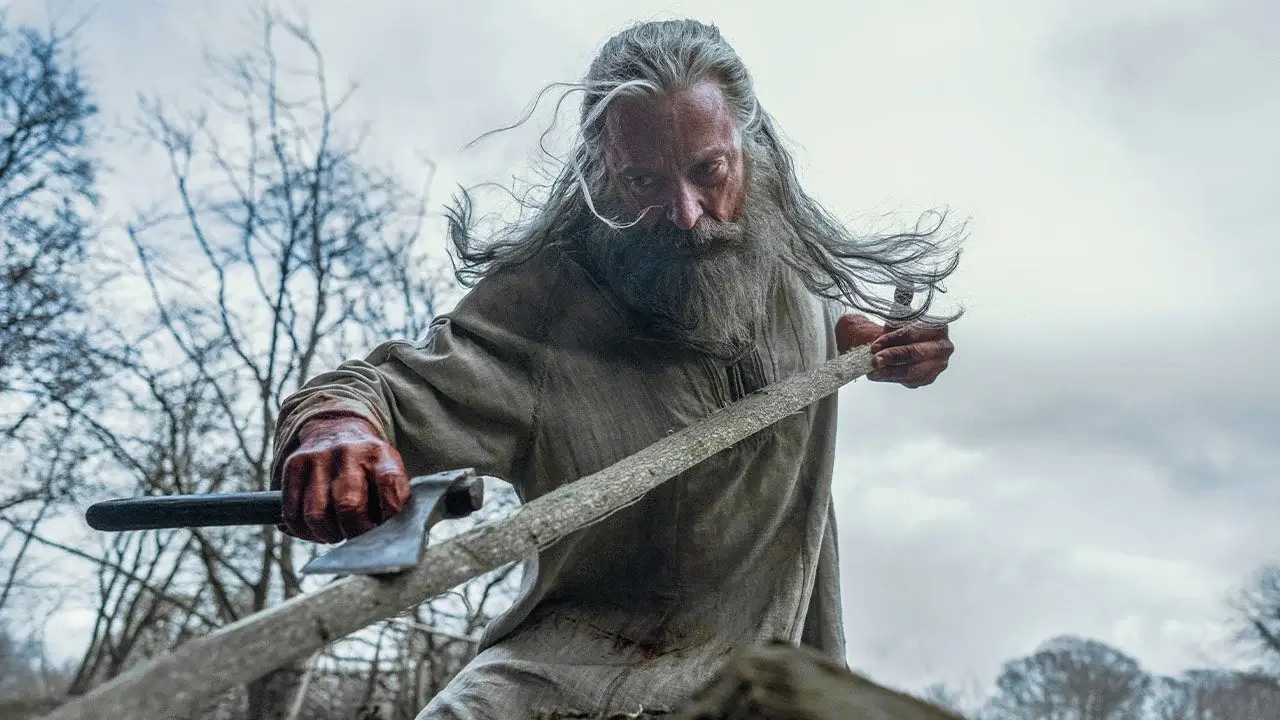
It would be easy to dismiss this Robin Hood as another entry into the “dark & gritty” library of updates on IP. Pat Scola’s moody shot-on-35mm camera gazes into puddles of black blood like a Nietzschean abyss. It is quite possible, though, that the film is the opposite, proposing that real heroism lives eternally in the small acts of service and the path of self-reflection. There is a certain amount left to the audience to decide, though the experience itself makes it clear: this Robin Hood is no hero.
Robin, or Randolph as he is known via alias in the priory, is in a typical second-act redemptive arc known to many a cinematic figure. You can change your ways through the attentive care of a selflessly good woman, a self-aware, lightly comic, doomed philosopher (Murray Bartlett’s Leper), and a traumatized child who needs his love (Faith Delaney). This type of arc is certainly well trodden, with Jackman even doing it himself before in the “end of the west” style superhero masterpiece, Logan.
What makes The Death of Robin Hood different than other members of its subgenre, and entries in its long (thousands of years, almost) running I.P. is its fascination with word-craft and story itself. In an early scene, Robin asks John to tell him about his wife in this second life he’s found, whom they must rescue, and he directs John’s storytelling; “Paint a portrait.” They craft the description together with careful adjectives. This scene suggests, as so much of the movie does, that much lies beyond the visible tale before us. The methodology in telling a tale is critical.
As the story goes on, we learn that Robin struggles more with the way stories about him were used, or misused, by him or others, than he does with the violent atrocities he’s committed. He questions the way men twist tall tales to gain favor. He can’t even remember the truths and fictions in his own life. It almost goes a little further than is believable.
While the movie may not consistently pack the large-scale action punch traditionally associated with the legendary, oft-adapted character, this incarnation is targeted in its brutality, with even more devastating blows coming in the form of dialogue scenes delivered in contexts that crush characters’ souls.
It is the words that pierce, not the arrows.
Casting Legacy Figures Well
Because there have been a lot of Robin Hood movies, there have been a lot of Robin Hood actors. More than we should list here.
Jackman’s a perfect aging heir to the swashbuckling lineage of yore; his career itself reflects the derring-do of Connery, Fairbanks, and Flynn. His Robin could easily be a later stage one of theirs, reflecting back along with us on whether or not all the murder was in fact ‘merry.’
If Flynn and Fairbanks represented a purely joyful and selflessly heroic variant on the tale, with the many attempts to blend that myth with some histrionicity along the way via Costner, Edgerton, and others, Jackman joins Connery as one of the only men to draw Robin’s bow in his later days.
It’s easy to forget that Sean Connery played Robin in Richard Lester’s Robin & Marian, a version that was initially titled The Death of Robin Hood before Audrey Hepburn’s presence as Marian required a shared title. In that version, Robin comes home from the crusades to find a world that’s changed, enemies still hunting him, and a final Romeo & Juliet style farewell.
The actual death of Robin Hood is, like the figure himself, shrouded in mystery. Many men existed in the general era who could have been the source for the Robin Hood legend, with variants on the name, people who fit the bill, and even the suggestion by some historians that the name was simply a common moniker for outlaws of the time. Legend goes that one such Robin Hood shot an arrow from the priory window that landed where a grave for him stands to this day. Sarnoski plays with this event and idea, layering slightly different literal actions to it, to try and conjure a new meaning for a new time.
In some ways, the death of Robin Hood, in this story, is about the death of heroic ideals, or the old versions of them. Death of the stories that we tell to mislead, perhaps building a counterbalance to stories we can tell to inspire. Though you could certainly take the ending multiple ways.
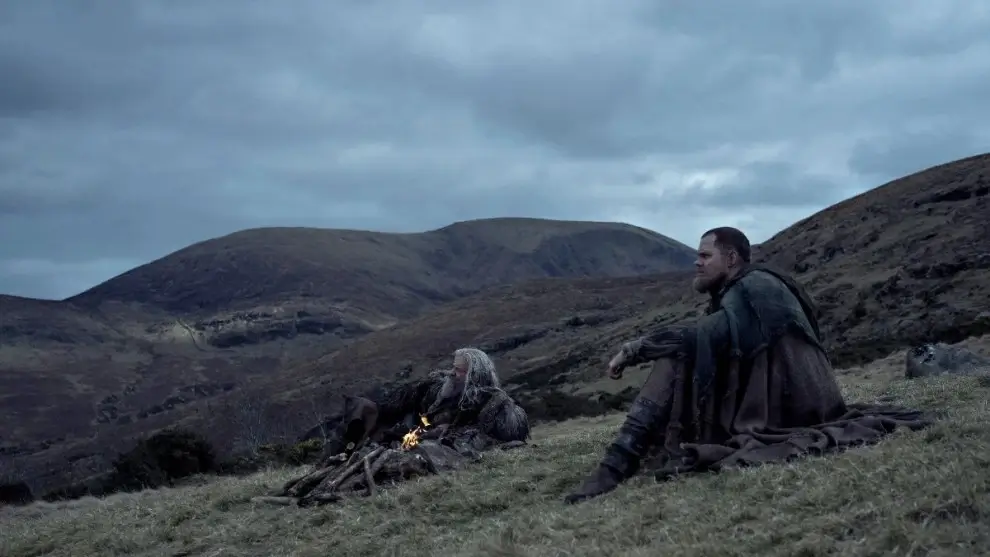
Another Misleading Tale? Or a Solution to an Age-Old Problem?
Stories are very much the subject here, and after all, how can they not be? Few stories have fascinated the English language for as long as this one. Robin Hood adaptations are ubiquitous; this one comes at a time when arrows of doubt are puncturing the hallowed tales of the past, questioning the righteous voracity of so many so-called heroic deeds, and the soiling of all that hagiography could be well-timed.
There is also a chilling connection to the crusades, not made explicitly by the film at all, but when you’re dealing with Robin Hood and 12th-14th century England and Europe, it’s impossible not to be drawn into that line of thinking. In many versions, Robin is returning from them, or at the very least King Richard is engaging in them as he historically would have been.
In Robin’s own time, legend wasn’t so far from fact. Men did deeds in far-flung lands, frequently receiving praise for committing atrocities, and all in the name of faith and righteousness. It is deeply unlikely any of them ever sat in deep reflection about what was wrong. Survival, faith, and power, all would have been satisfactory justifications. True, fair, or otherwise.
If for so many years we blindly assumed righteousness on behalf of a merry band of outlaws, it’s perhaps refreshing to think of it as wrong to kill at all, no need to get into justifications. Especially as we look to current events, where violence between east and west persists over holy land. The lies told as justification of hate and outright extermination of ‘the other’ knows no end.
At the same time, don’t we need heroes in myth to believe in? Is it so great to sully one of our purely righteous myths? Don’t we have enough real world examples of those who twist words, pervert meaning, and get away with murder?
There is a lot packed in this film about religion and faith, how stories and meanings come from language choices, and how the balance of what we do in communication isn’t that different from the balance of a well-crafted bow.
The Death of Robin Hood is a fresh take on an all-too-familiar tale. Yet there is something to be said for still believing in heroes.
For more Reviews, make sure to check back to That Hollywood Show.


![Deadpool & Wolverine - Heartfelt, Vulgar Return To Form [Review]](https://thathollywoodshow.com/wp-content/uploads/2024/07/a6aa06c6-eba6-4df3-b4a7-cd9ed2aa6511-960x540.webp "a6aa06c6-eba6-4df3-b4a7-cd9ed2aa6511")






Reviews