
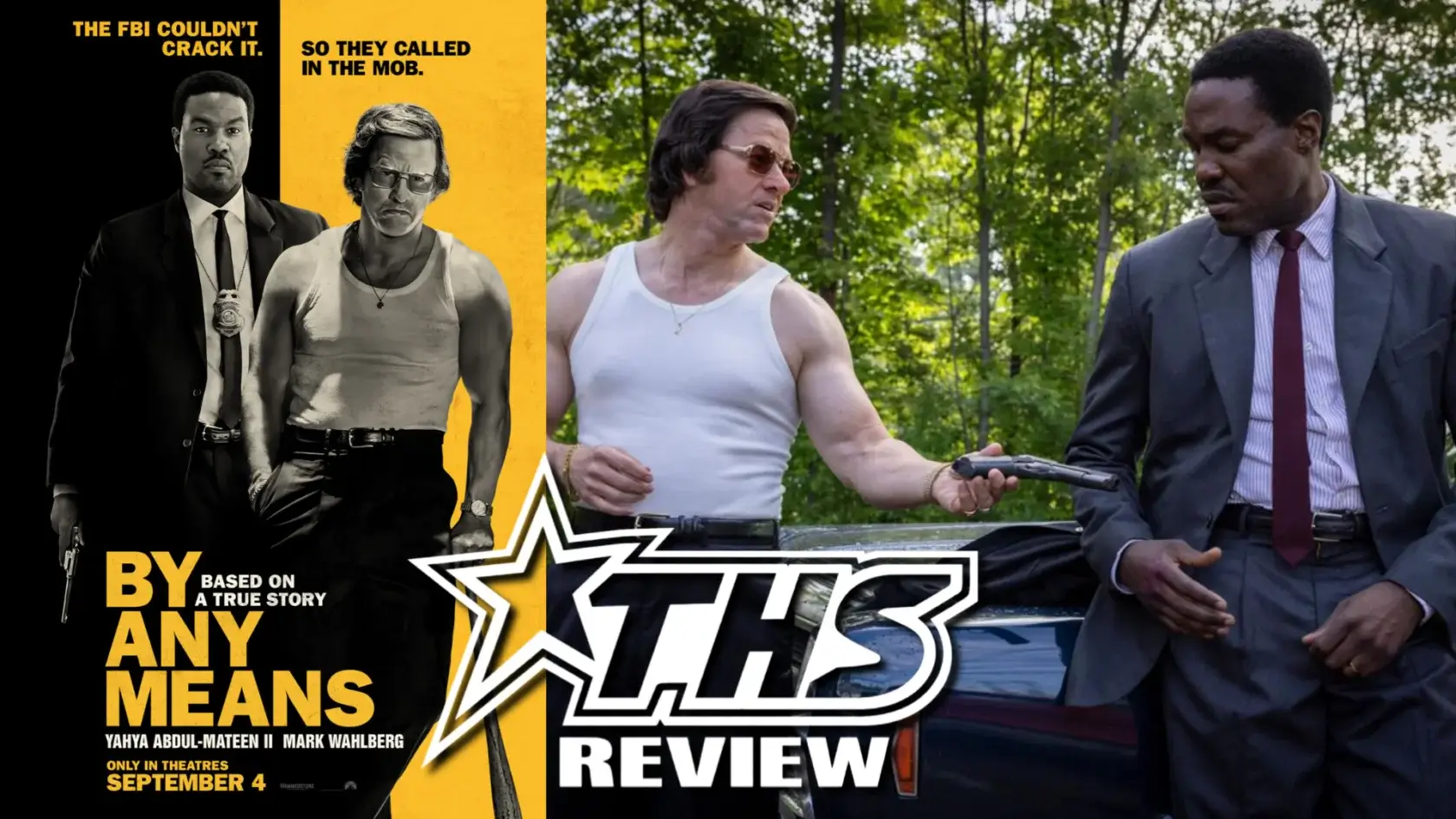
“By Any Means” treads familiar ground, but Mark Wahlberg shines as real life Hitman-turned-Fed informer Gregory Scarpa, and behind the tropes and cinematic conventions is the kernel of a true story that has relevance to this day.
Mark Wahlberg is distracting (mostly in a good way) throughout the period thriller “By Any Means.” As real life mob hit-man turned informant Gregory Scarpa, Wahlberg is gleeful in his brutality, sinking his teeth into the kind of DGAF dialogue he did so well in “The Departed” so many years ago. Wahlber’s career has traversed almost every genre, and no matter what turns its taken, it’s impossible to ever forget how downright hilarious he can be, dating back to his star turn as Dirk Diggler in Boogie Nights, almost 30 years ago.
Go back another 30 years and we’re in the time of “By Any Means,” a nation divided by culture war (sounds familiar) where white nationalists who avoid repercussions want to prevent minorities from voting. Also, sadly, sounds familiar.
How we can be here in 2026 with events from 1966 feeling this relevant approaches a darkness the film doesn’t quite tackle. Hopefully audiences draw some connections to some of the vitriolic rallying cries of today, when Klansmen gather and discuss the danger of black people voting, it should be impossible not to consider modern ay gerrymandering and redistricting as we approach a pivotal mid term election. There are people with great power who are not hiding these views in backrooms anymore. They are saying the quite part very, very loudly. If it does nothing else, one hopes ‘By Any Means’ can serve to remind us what we’re supposed to stand for, what is at stake, and what evil looks like.
What is By Any Means about?
The plot of the film surrounds the actions of a ‘by the book’ cop who believes in justice and wants to bring those who break laws before it. He’s partnered with Wahlberg’s every man for himself Scarpa who beats confessions out of people for the feds. Yes, it’s a good-cop/bad-cop two-hander, and yes this also sounds quite familiar.
What does differentiate “By Any Means” from the rest of the pack is that the ‘good cop’ is black federal agent Wayne Strider (loosely based on real life Lindley DeVecchio) returning home to Mississippi after a sojourn to Chicago where he met his wife. We spend a decent amount of the films tight (by today’s standards) 1 hour and 47 minute run time establishing this fact, as well as our Strider’s penchant for seeing right from wrong and his relationship with local civil rights leader Vernon Dahmer, who is murdered by the Klan setting things in motion.
The feds decide to do things the dirty way and assign Agent Strider to be Scarpa’s handler as he gets his hands dirty pulling confessions. Wahlberg is having a ball with the brutality and the asides, his character occupying some sort of unique kind of tolerance for all people and things in his mocking distaste for them.
The buddy part of the movie never quite takes off as the men hate each other and ‘break up’ per the conventions of the genre, only later seeing how they need each other to complete the mission, or in their words ‘end this.’ And yes, at one point someone is also asked to ‘turn in their gun and their badge.’
Wahlberg busting heads and cracking skulls with his strange prosthetic nose and mop of 60’s hair is a sight to behold, though; he’s having fun, and it’s contagious. The film never considers that these Klansmen deserve mercy, and their suffering in torture scenes is certainly well-earned. Strider and Scarpa engage in philosophical debate about how effective violence can be as a deterrent, what the right course of action is in an unjust time, and whether their place in all this is to just be dirty work muscle for men behind podiums, microphones, and desks. The film asks these questions in dialogue, but answers them in action. In a time like ours, just as it was in a time like theirs, the ends may very well justify these means.
Particularly when the film’s coda reminds audiences how stacked the deck of the judicial system can be, how many men who commit hate crimes get off light, and how many men operating above the law still plague our world.
It’s never as simple as Scarpa makes it out to be, and Strider’s character seems to register that in the haunted but determined final scenes of Yahya Abdul-Mateen II’s performance. He never gets to do much but play the Dudley Do-Right straight man until his arc comes around at the end.
The movie does belong to Wahlberg, a star with a distinctly limited range who can hit so perfectly in the right role.













Reviews