Dear Matt and Ross Duffer, You did it. Thank you. You somehow managed to create one of the first hits of the streaming era and keep us engaged with it for a decade. You gave us something that never wavered in quality. Something we’ll be able to enjoy for the rest of our lives. You should be proud.
Now that we’ve had a few days to digest that Netflix Stranger Things series finale, one thing has become abundantly clear…. Some “fans” are simply not satisfied with anything. For perspective – I love Star Wars, but the fan base is unquestionably one of the most toxic fan bases out there.
There was a great worry that Stranger Things would not be able to stick the landing. It wasn't quite closing out the Skywalker Saga for Star Wars, but it was close. A series that was a decade of cultural juggernaut. This was the thing that put Netflix on the map, the dragon they've been chasing
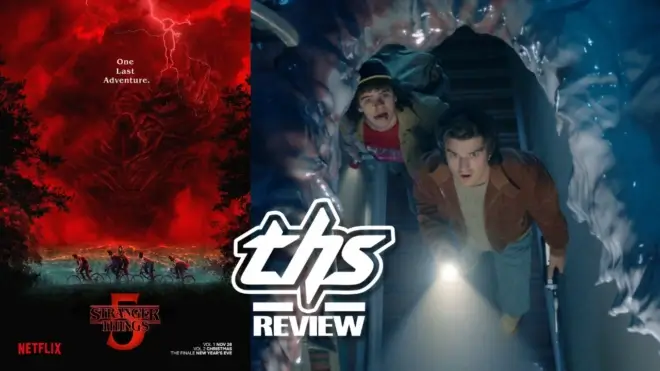
Stranger Things is coming to an end with its season 5 volume 3 drop, and everyone is on edge. There is a lot to unpack in the show's finale episode, and its runtime proves it. The over 2-hour finale has to wrap up Vecna's (Jamie Campbell Bower) evil plan, fix Hawkins, and all while allowing its
After years of Dungeons & Dragons, demagorgons, and everything else the Duffer brothers have thrown at us, it’s almost time to visit Hawkins (and the Upside Down) for the last time. Netflix’s hit supernatural series Stranger Things will end tomorrow. And as we head into the show’s final
Stranger Things, like plenty of things has been a cultural phenomenon that has a hard time sticking the landing. Think about other properties, Star Wars: The Rise Of Skywalker (despite my glowing early review), Game of Thrones, The X-Files, there are plenty of things out there that have a difficult
"The Debut" turns a comedy that pokes fun at the sincerity of the local stage and elevates it to a fascinating character study of a woman on the edge. While still being hilarious.
In Ink, Danny Boyle explores the launch of the British newspaper The Sun. The tabloid was created as a paper full of things people want to read but feel they shouldn't. It broke ground in 1960 in London for speaking openly about sex, putting sport on the front pages and embracing the working man.
Few studios have set such a precedent within their own genre quite like Laika Studios. With each painstakingly crafted story, they consistently find new ways to level up stop motion animation and push the limits of what can be accomplished. Stop motion is already a marvelous feat of patience and