
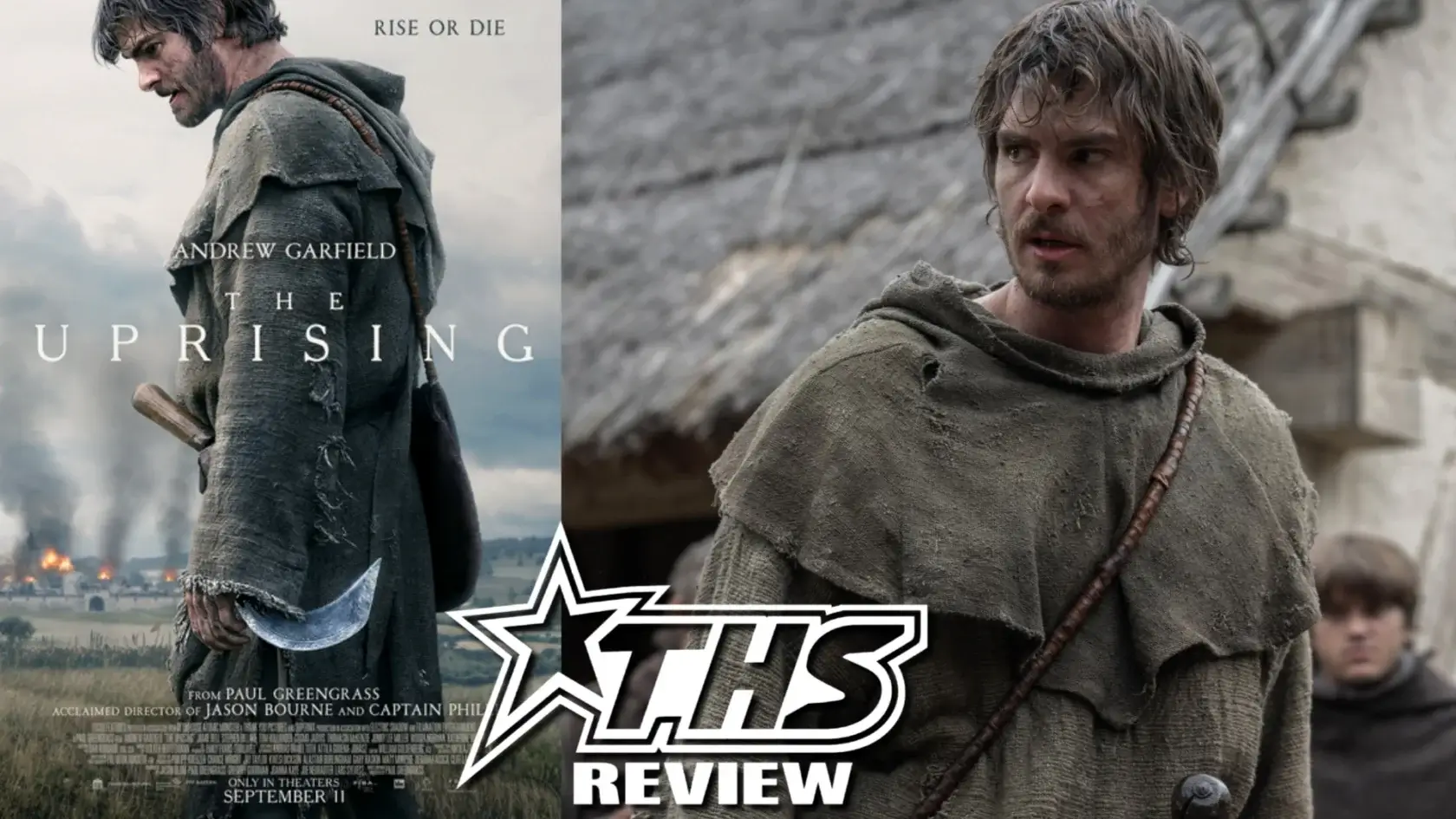
There will be many moments during Paul Greengrass’s new film The Uprising that create chilling parallels to recent historical events. His exploration of the 1381 peasants revolt in Medieval England is rooted as much in historical fact as it is relevant to the present day.
Some of this is clearly by design; some of it is simply the nature of history doing one of its favorite things… repeating itself.
It’s hard not to see throngs of angry mobs ransacking what stood in for offices and places of law and order in the medieval world, or pillaging and rioting in busy city streets, and think of the 2020s. It’s hard not to see a ruling class squeeze a working class to the breaking point with zero remorse and think about people today who would call themselves kings, and the sycophants and oligarchs who huddle close beside them.
The Uprising opens with a ploughman ploughing a barren muddy field. Andrew Garfield plays said ploughman, and he has lost his family to the plague (the black death), which we are told wiped out half the local population. This character is one of the few major characters in the film that was not a part of actual history. Or was he, perhaps in a non-literal sense?
Amazingly, so many of the events inThe Uprising are depicted more or less as we understand them to have taken place. Renowned historian and author Dan Jones, who literally wrote the book(s) plural on this topic and its historical context, advised on the film, and you can feel that authenticity even if you don’t know what actually happened.
Historical fiction at its best
What we know, of course, is what was written by those who won, and those who ruled. Spoiler alert: unless it’s Robin Hood (which, in some ways, this is, but that’s a point we’ll have to return to later), these kinds of freedom-fighting underdogs don’t win often in the history books. The lofty ambitions of the peasants’ revolt signaled something critical, and served as an inflection point for the people during an inflection point for the Plantagenet dynasty itself (led here by 14-year-old Richard II).
Wat Tyler and John Ball are two well-documented ‘ringleaders’ of the revolt, and they are here as supporting figures to Andrew Garfield’s ploughman, who we learn quickly and clunkily represents the spirit of the people more than anything else. He engages in dialogues with the king and queen mother that no farmer ever would. It is entirely and unabashedly an invention of the movie, from the idea that such a scene could take place to the words exchanged within said scenes.
It’s hard to say if it’s a ‘flaw’ or if it’s just business as usual and reasonably expected in any such story. We know so much of what Mel Gibson did in Braveheart (where another doomed rebel takes on Richard’s great-great-grandfather Edward I) was entirely invented for dramatic purposes. In many ways, The Uprising is closer to fact, though its leading man is literal fiction.
Mixing the real story with a new twist
There is something beautiful, though, about trying to turn the story of the people we know so little about because of written history’s focus on those who win and rule into a kind of individual personage. In a year where The Odyssey, a very modern take on a very ancient text based on spoken word about events lost in history’s haze, has made a billion dollars, it seems fair enough to dramatize an event we know happened in ways that “feel” right, narratively speaking.
Then again, history itself is often strange enough. It’s important to note that Tyler and Ball, and their revolt, are considered by many to be the foundation of Western concepts of socialism. These are actual things we know a lot about, and they do not need help to be powerful and important.
Serfdom is an alien concept to the majority of the modern movie-going audience, and so to see the people of 1381 England taxed unfairly initially may bring to mind modern parallels that don’t quite make sense. This isn’t a tax for a government to provide any kind of services, good or bad. This is a lord taxing the people he owns who work his land. Many of these people have nothing, own nothing, and are worth less than nothing. They are mostly forgotten to time, and what is known of them is known in bits and pieces, often obscured by bias.
Long live the King
King Richard II and his court, however, are far easier to wrap our minds around factually. Richard was thrust into kingship as a boy when his father, Edward IV, known by the sobriquet the Black Prince, died unexpectedly. Richard’s grandfather, King Edward III, was a successful expansionist, having won great battles in the north and on the continent. All of this and more is packed into the small moments onscreen when we meet Richard II and his mother, Joan of Kent (Katherine Waterston). The Richard of the film is terrified, paralyzed by fear of his dreams, with a council that dominates him and decides everything for him, much to his mother’s chagrin via disapproving frowns.
What is interesting is Greengrass’s decision to show Richard’s arc as both triumphant and villainous. There is plenty of evidence to support either take, with historians often considering Richard’s eventual rise to the occasion of the revolt as the lone success in what would be an absolutely disastrous rule. The miserable and pathetic end of the real Richard II is actually never mentioned at all, even as the film tries to give him some kind of visual/dramatic embarrassment that, as far as we know, never took place and belongs in something more like a Robin Hood movie.
Richard’s father, the Black Prince, was beloved, often considered one of the great examples of chivalry and the chivalric code. Edward III’s reign was marred by war and the plague, but also a time of great victories and greater celebration. When we see the queen gaze at the tomb of the Black Prince, asking for guidance, we are meant to consider or feel that lost leadership emanating from the death mask.
At the same time, Richard II’s abrupt turn when cooped up in the Tower of London, under attack, watching London burn, feels a little bit unmotivated. Not that he wouldn’t have frustrations, but that he would suddenly and definitively become brave, calculating, and deadly, which he is in respective order.
Modernizing the Peasants’ Revolt
Much like The Odyssey, The Uprising modernizes the characters and interactions in ways that serve the movie-going experience of the 20th and 21st century but seem almost out of place and incongruous to the world represented. There are many conversations questioning God, certainly not a common topic in these parts during 1381. There are characters reliving trauma and backstory to fill in gaps, create empathy, and drive narrative choices. John Ball, who was in many ways a powerful early voice to suggest that no man is any more anointed to connect to God than any other, is turned into a bit of a nut case, bloodthirsty and desperate for the vengeance that perhaps tips the scales against the rebels. He also makes a strange choice about his fate that was not historically accurate either. Jamie Bell does a fine job, but the actual man, or what we know of him, could have offered so much more.
Wat Tyler, by way of Cosmo Jarvis, mumbles his way around at times being impossible to understand at all. The actual man’s real strength of character and purpose is sapped by the creation of the ‘every man’ Ploughman for Garfield. Jarvis’ performance isn’t particularly memorable or noteworthy outside of a pretty unique haircut. It is worth mentioning that to some the event is referred to as Wat Tyler’s Rebellion. It would be hard to see this movie and come away feeling that it was in fact ‘his.’
Thomasin McKenzie as Alyce is given the entirely thankless task of playing a mirror held up to Garfield’s Ploughman. She is there to react and is the face in the mob we know best, adding a mildly personalized yell to the cacophony coming from the countless extras. Alyce is also burdened with backstory she has to deliver exposition-style in a scene where the movie needed to keep moving and probably not take a break to talk about “why we’re in this” and “what keeps you going.”
Stephen Dillane and John Hollander chew the scenery as the key evil advisors on the King’s council, stock characters in both history and cinema alike. Jonny Lee Miller looms large as William Walworth, mayor of London and eventually Richard’s muscle.
Waterston does a fine job as Joan of Kent; she serves as an emotional link to a backstory we aren’t told explicitly, but rather skillfully through her moments with her dead husband’s tomb and her impossible conversations with Ploughman. Joan and the Black Prince’s marriage was actually romantic, swirled in Arthurian mythos, and said to be one of the few noble marriages built on love from the era. Is all this conveyed in her small moments? Not really. But some of it is at least intimated.
The movie really belongs to the trifecta of Greengrass’s notorious action camera, Andrew Garfield’s performance, and young Woody Norman tasked with bringing Richard II to life.
The latter is no small feat, with Richard II having been associated with Shakespeare among other things. To hold his own in scenes like these against actors like this is impressive, and Norman rises to the occasion without missing a beat. There is never a moment when he seems to be up to the task.
Greengrass’s visual technique is perfect for this type of action. We are thrown into violent chaos and knowing who lands which blow actually wouldn’t make sense anyway. The frenetic energy is appropriate, and he tempers it with some more choreographed action, slow motion, and perhaps out-of-place drone-style shots of era-accurate London.
To be Robin Hood or not to be
Garfield’s job is probably the hardest. He must portray the ‘spirit of rebellion’, as it were, a kind of medieval Tom Joad, who not only is there for all the moments, but must have his own modern-day ‘arc’ woven into it, plus action scenes and fights that would make more sense were he donning his infamous blue and red tights again, rather than portraying a simple farmer. The power of myth grows as we get a coda to the story where Ploughman transforms, basically, into Robin Hood. There is certainly something to be said for the idea that things like the Peasants’ Revolt, and men like Wat Tyler and John Ball, may have fed into the ideas and individuals that aggregate into whatever Robin Hood was or wasn’t.
Robin Hood is as hard to locate in history as King Arthur. If he was to be fixed in a time and place, it’s usually a few hundred years earlier with Richard II’s great-great-great-great-grandfather King John. But there is that thing of history repeating, and the ebb and flow of Medieval monarchy would lead to many Richard II/Johns, and we assume many Robin Hoods.
If there is a message to Greengrass’s film, it is that there should be ‘no Kings’, a modern-day slogan in protests and an actual line of dialogue in the movie. Greengrass wanted to show a people who believed in a King lose their faith; he wanted to show a people rise against injustice; he wanted to show the spirit of rebellion live despite whatever setbacks it finds in the field of war, or in words written and unwritten as law.
In this sense, his film is both timely and evergreen. The moments that don’t work, or choices that could have been different depending on taste, do little to change the obvious importance of remembering those who had nothing to give but gave even more in the hopes that someone like them one day could call themselves free.











Reviews