
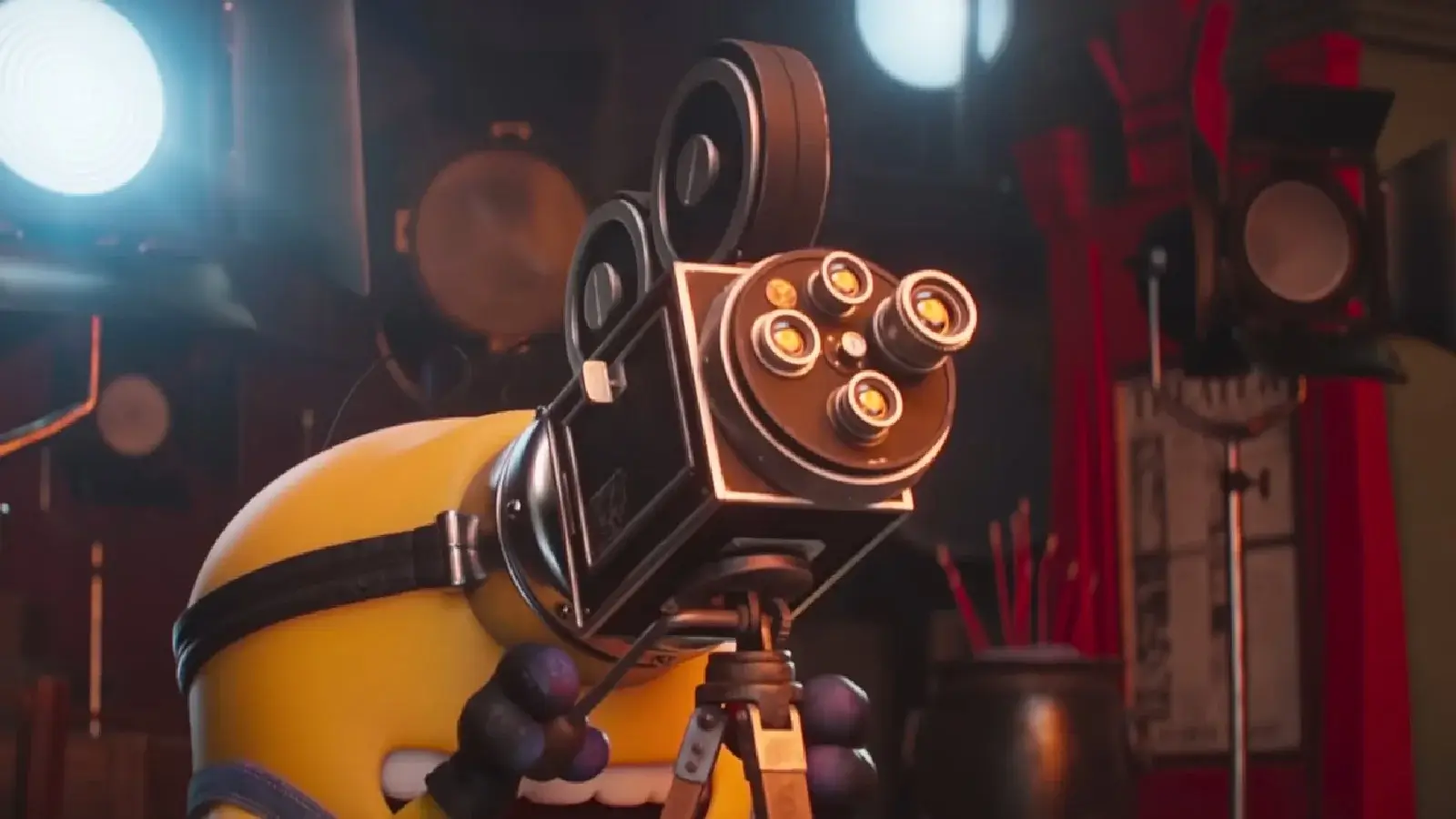
Minions & Monsters, the latest offshoot of Illumination’s Despicable Me franchise and the third of its films following the yellow underlings known as Minions, is here! Once again it’s a delightful showcase of our Twinkie-coded henchmen who charm, search for another big villain to follow, kill said villain from incompetence, and repeat.
This time, however, things are slightly different. Yes, we’re following a Minion tribe in perpetual search for an evil overlord they can’t kill (how did Gru survive this long, anyway?), but in Minions & Monsters our journey takes us into Hollywood’s heart during the transitional era between the silent films of yore and the sound pictures that followed. Between that star-studded setup and the monster chaos that’s unleashed, it’s a brilliant animated outing that’s packed with references to classic Tinseltown. Here are a host of the ones you shouldn’t miss.
Movie Montage
Appropriately enough, Minions & Monsters begins with key moments in early film history. We see a variety of Universal Pictures logos over the years, before the opening titles situate minions interacting with some of the works of early film pioneers including Eadweard Muybridge, the Lumière brothers, and SFX pioneer Georges Méliès. Referenced classics include Muybridge’s The Horse in Motion (1878) and Dog Running (1887), the Lumiere’s L’Arroseur Arrosé (1895) and Workers Leaving the Lumière Factory (1895), and Méliès still-magical A Trip to the Moon.
A Day at the Museum
The film pivots to with a tour of a movie museum in the modern era, where we’re first introduced to Henry and James (both voiced by Pierre Coffin, as all Minions typically are). The room is loaded with displays from legendary Hollywood films including the robot from Fritz Lang’s Metropolis (1927), nods to Universal Monsters with The Mummy (1932) and The Creature from the Black Lagoon (1954), a nod to Michael Curtiz’s brilliant Casablanca (1942), 20,000 Leagues Under the Sea (1954).
There are explicit nods to iconic directors like Orson Welles, Alfred Hitchcock, and George Lucas (who in-world is the real Lucas trapped behind glass… ever a great sport, he voices his own character) alongside increasingly modern fare like Spielberg’s E.T. the Extra Terrestrial (1982) and The Matrix (1999). The setting is loaded with detail, but the film returns to it periodically, so there are multiple chances to catch the torrent of references.
Journey to Silent Era Hollywood

The Minions’ search for a master who can withstand them takes them through variably subtle nods. The emphasis on extensive rowing feels reminiscent of Ben-Hur (1959), as they make their way to a destructive Cyclops vaguely reminiscent of Ray Harryhausen’s magnificent Clash of the Titans (1981) animations. They eventually make their way to a sorcerer that calls to mind that of Fantasia (1940), with just as chaotic an apprentice. A train heist a la The Great Train Robbery (1903) and The General (1927) sends the Minions to Hollywood.
Like Singin’ in the Rain (1952), The Artist (2011), and Babylon (2022), Minions & Monsters takes place during the tumultuous period when the silent film era gave way to the ‘talkies,’ and its loaded with references to icons of the silent era as the Minions spread their cute chaos around. They leave an animated man who looks like Harold Lloyd hanging from a clock a la Safety Last! (1923), knock a Charlie Chaplin lookalike into factory gears a la Modern Times (1936), and collapse a house on a Buster Keaton-visaged character a la Steamboat Bill, Jr. (1928).
Minion Movie Mayhem
The Minions’ stumble into Hollywood sees them encounter the director Max (Christoph Waltz), stumbling into his latest shoot. He shows the footage to the Bright Brothers (Jeff Bridges), who love the small saffron showmen. They encourage Max to bring them into the movies, and ask a piano player named Sam to “play it again” in a nod to Casablanca. The Minions’ time in Hollywood is loaded with both subtle and overt references. Their audition involves a fight against vikings in a reference to 1928’s The Viking. A montage of scenes and posters ensues, with a nod to the first Best Picture winner, Wings (1927) and a Minion reenactment of the opening scene in Citizen Kane (1941) among them.
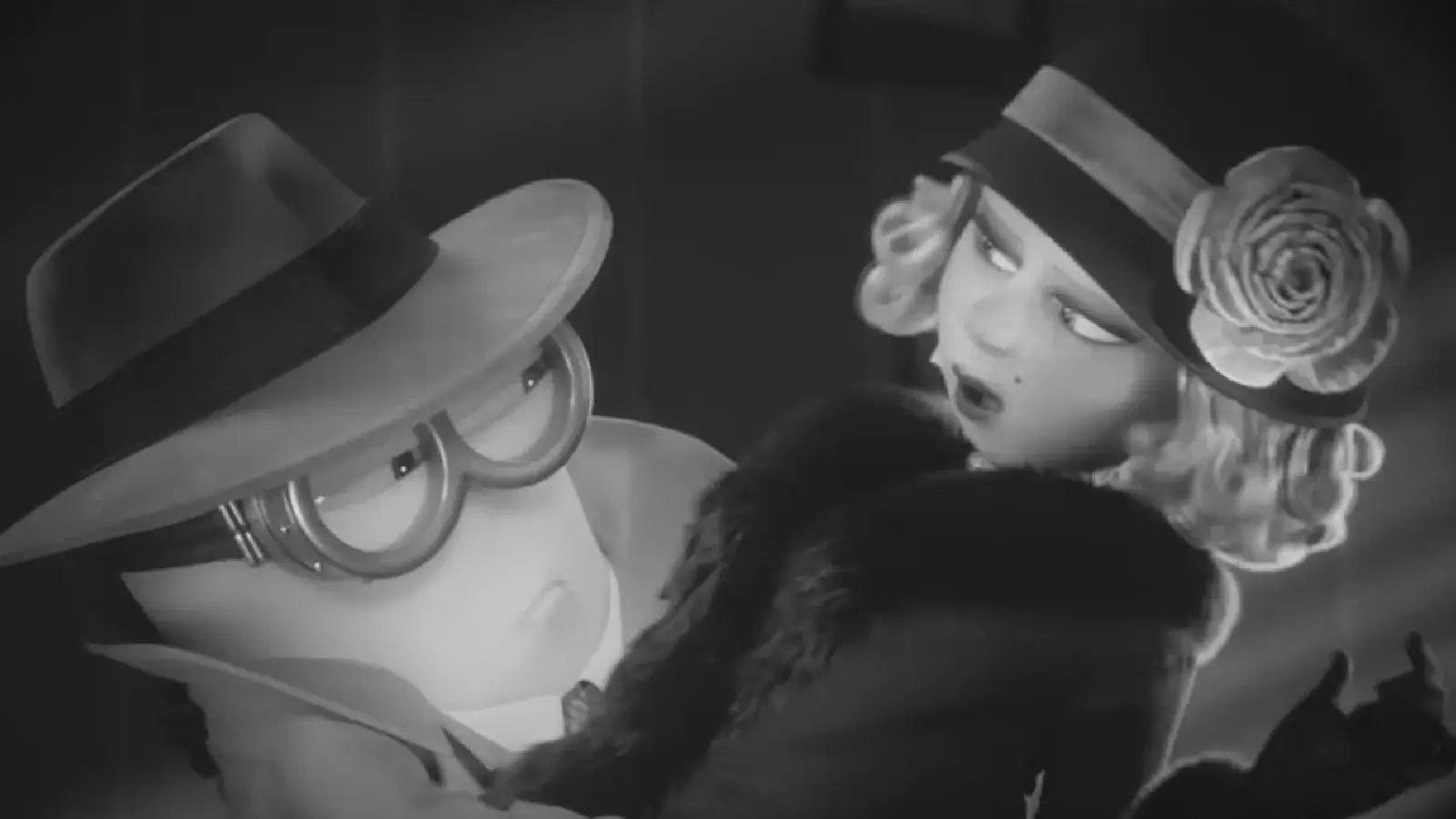
The Minions are shown at a riotous Hollywood party with elephants parading through, a la 2022’s Babylon, while the Minions’ Hollywood dreams are dashed when the pivot to sound pictures reveal their linguistic limitations. A Noir-esque romantic scene inspired by The Maltese Falcon (1941) is ruined when “Mary” (Mary Astor starred in that picture) attempts to romance a trenchcoat-wearing detective, Humphrey (think Bogart), when Minionese comes out and ruins the moment, and with it, the Minions’ careers as on-screen talent. It’s worth noting that the ‘actor with a voice that doesn’t work in the talkies’ beat is literally lifted from Singin’ in the Rain. With their fleeting Hollywood stardom dashed against the rocks, James comes to want to make his own monster movie, which Max encourages… but how to find a monster?
Robots vs Monsters
Wanting to make a monster movie specifically is a fun nod to Universal’s influencial history in the genre thanks to films including The Phantom of the Opera (1925), Dracula (1931), Frankenstein (1931), The Mummy (1932), The Invisible Man (1933), The Bride of Frankenstein (1935), and others. Thanks to the spell book the Minions kept from that Fantasia-esque wizard, they conjure Goomi (Trey Parker), a little green creature clearly modeled after Howard Phillips Lovecraft’s famed ocean-dwelling Cthulhu. Goomi swears he knows the perfect monsters for James’ movie, and gets him to unleash a pair of aquatic-themed beasts, Howard (Phil LaMarr) and Phillips (Bobby Moynihan)… another cute Lovecraft reference.
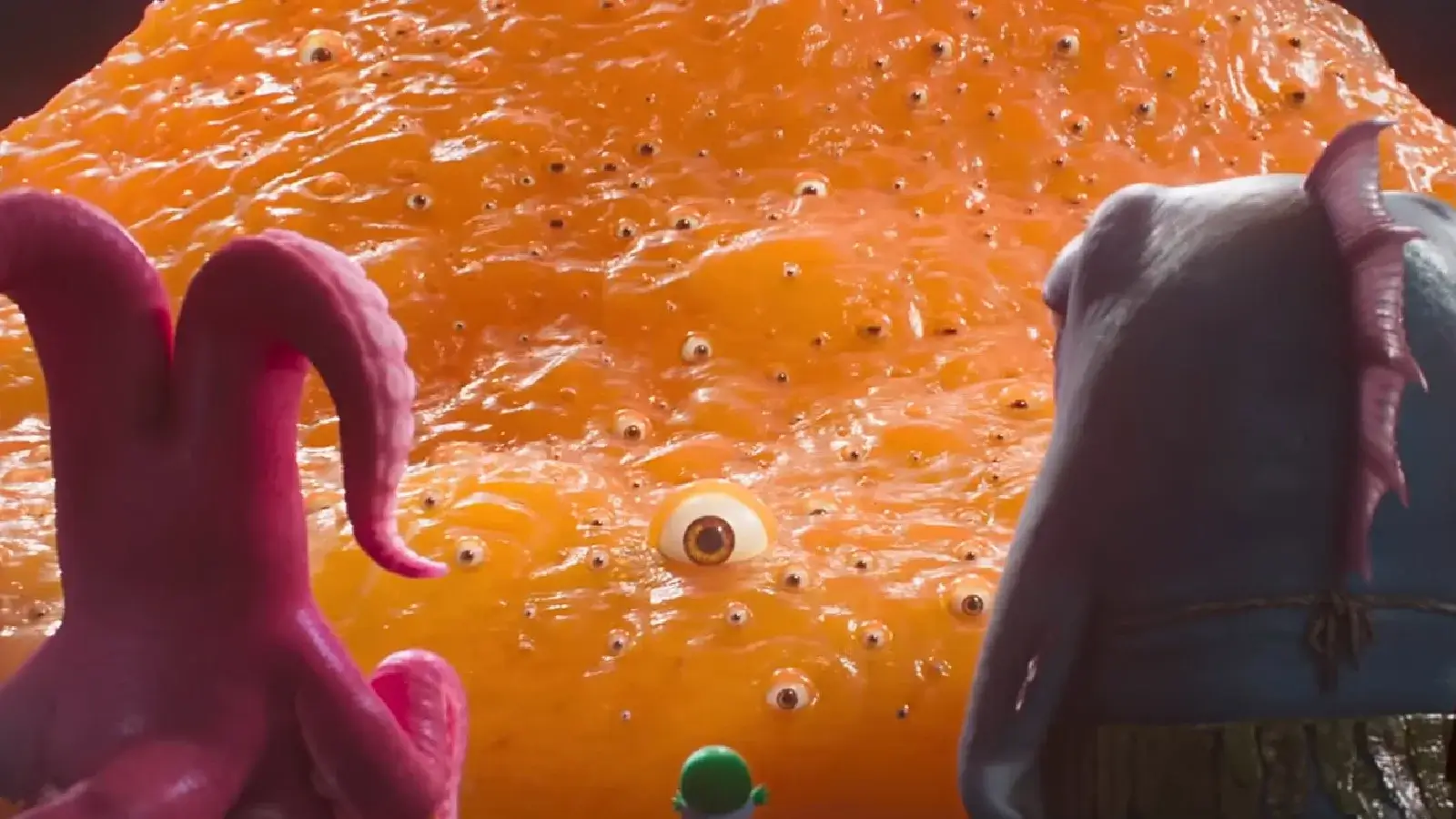
Goomi’s real master plan is to unleash a massive, world-consuming blob named Irene, and he tricks Henry and James into doing so, unleashing the orange eye-covered beast onto our world. That’s a reference to the famed all-consuming amorphous mass in The Blob (1958), though the latter doesn’t have visible eyes. What ultimately saves the day for an endangered Earth is the emergence of Dort (Jesse Eisenberg), a would-be world-conquering alien robot who discovered a soft side after falling for the sufragette Debbie (Zoey Deutsch). Dort’s a reference to Gort, the powerful alien robot from The Day the Earth Stood Still (1951), who arrives with a fleet of Minion-piloted alien spaceships of the flying saucer variety, famously found in movies like the above 1951 classic, alongside Invaders from Mars (1953), Earth vs. the Flying Saucers (1956), and others.
Altogether, Minions & Monsters is a beautiful love letter to classic Hollywood and cinema history, all packaged in one of the best Minions films yet.
-

Marvel Unveils New Slate Of TV Shows At New York Comic-Con 2026
Marvel had a huge panel on their television and animation slates on the Empire Stage at New York Comic-Con 2026. The panel was hosted by friend of THS Brandon Davis and included a surprise screening of episode 1 of VisionQuest, and some major announcements for the future. They kicked things off
-
 Score: 6.5
Sasaki And Peeps Ep. 13 “Mother And Child”: Jeepers, This Is Getting Creepers [Review]
Sasaki and Peeps begins the new second season by making the story increasingly creepy in Ep. 13 “Mother and Child”. It’s creepy in some good ways, but a lot of the creepiness is in bad ways too. With a lot of the creepiness occuring because of Sasaki’s teenaged neighbor, who gets a disturbing
-
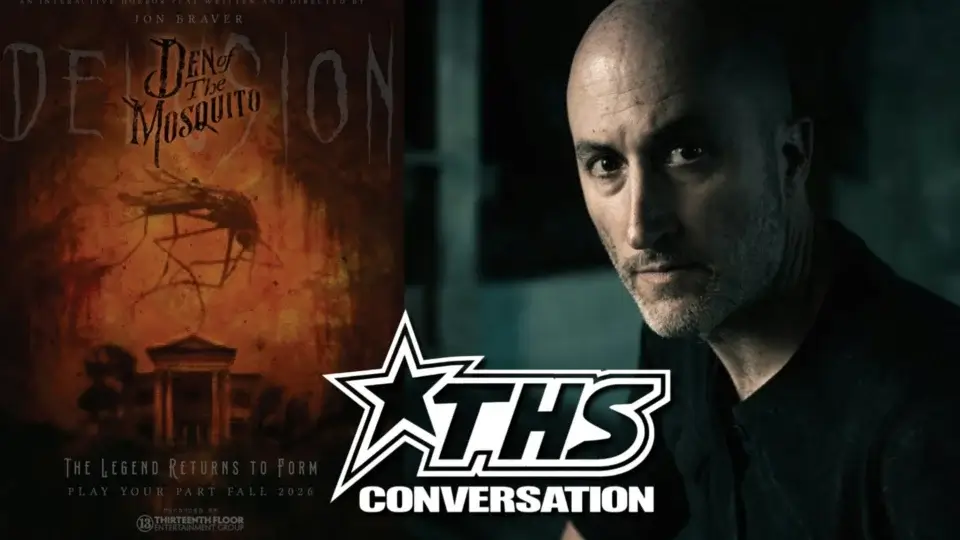
Jon Braver Talks The Best ‘Delusion’ Yet [Interview]
Delusion: Den of the Mosquito is running in Los Angeles right now. The event is a live-theater attraction that places you in the middle of the story. We got the chance to sit down with creator and director Jon Braver to talk about the attraction and future plans for the event. Check out the
-
We Chat With the Stars of Mike Flanagan’s “Carrie” [THS Interviews]
Carrie (2026) is coming to Prime Video and it’s a bloody good time! Mike Flanagan’s new horror series follows a young, socially stunted girl who just wants to get some control back into her life. She believed she was powerless, but as the series goes on, Carrie (Summer Howell) discovers she has





What Might Come After the Multiverse Boom
Every era of genre storytelling eventually hits a saturation point: grimdark reboots, found-footage horror, YA dystopias. The multiverse probably isn’t going away completely, but it will stop being the default twist.
What’s likely next:
- Smaller, character-driven arcs inside big franchises
- Self-contained seasons and films that don’t require a viewing checklist
- New “hooks” built around tone and format (anthologies, limited-series experiments) instead of timeline gymnastics
When the dust settles, the multiverse stories that last will be the ones that used the concept to say something true about their characters, not just their continuity.



![The “Digger” Complex: Satirical Deconstruction Through Nihilistic Cynicism and Movie Stars [Spoilers]](https://thathollywoodshow.com/wp-content/uploads/2026/07/diggers-1500x844-1-960x540.webp "diggers-1500×844")



Reviews