
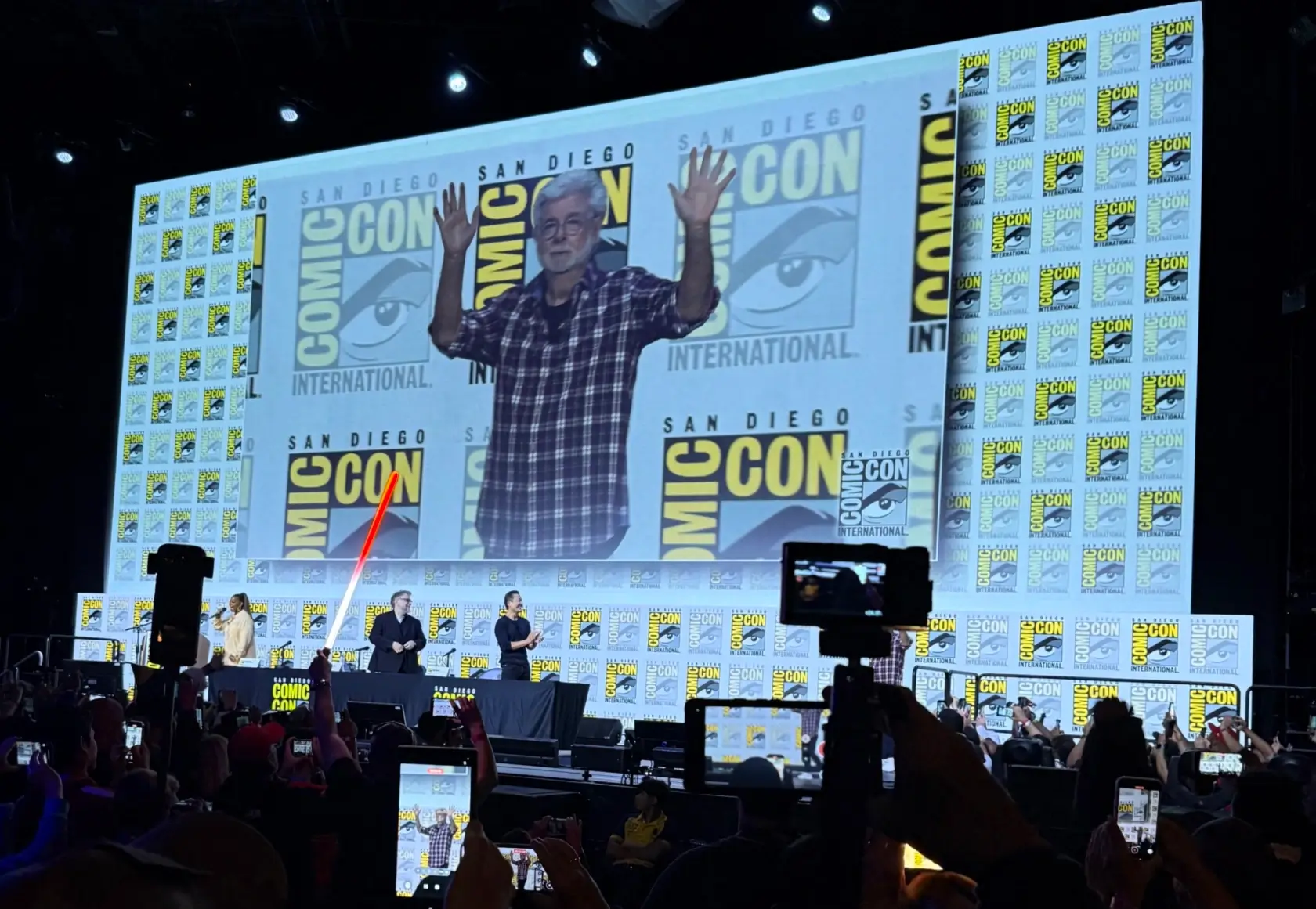
George Lucas says he embraces AI, and the internet roasted him for it. But if you read the interview and take his comments in larger context, you’ll see Lucas isn’t accepting AI as a fix-all solution. He’s arguing that no tool can replace a storyteller who actually has something to say, a passion for the medium, and an understanding of humanity.
More Machine Now Than Man?
Nobody should be too surprised that George Lucas, in a recent interview for A Rabbit’s Foot about his new museum opening, made it clear he does not fear and rather embraces “AI” as it comes for the world writ large.
Lucas may have made his mark on this world telling a story about ragtag heroes who upend a “technological terror,” but as the years have passed, when it came to filmmakers, it seemed easier and easier to think he was himself like his singular creation, Darth Vader — i.e., “more machine now than man.”
To countless commenters on the internet (who have roasted Lucas for generations now), this is an example of Lucas fulfilling a prequel meme moment, “You were the chosen one!” yelling at him as he embraces the dark side of LLMs and creativity. The fan community, certainly the most verbal and creative one, clearly doesn’t like “AI slop.”
But everyone is wrong about this. Wrong about Lucas, but also probably wrong about AI/LLMs and what he’s trying to say.
And it’s no surprise that quick-hit social media culture would catch fire over misunderstanding quotes, or a public figure, or Star Wars. Hell, those have practically been the three pillars of social media since day one.
Here is what Lucas said, and we’ll take it alongside another comment to get a better sense of what he’s really talking about here and what it actually means.
“Artificial intelligence means it’s much easier for us to make movies. It’s very much like sitting here saying, ‘Well, I believe the horse and the buggy is really where it’s at. These cars, they break down, they need gas, there’s all kinds of problems with them and pretty soon they’ll be making them into tanks, and then they’ll be killing people. It’s terrible.’ There’s nothing you can do about it. That’s progress, it’s the future.”
It Can’t Replace You If You’re Actually Good
First off, it’s important to call them LLMs and not “AI” because, let’s be honest, these things aren’t actually intelligent. They are very much tools, powerful tools that are pulling off some crazy things for productivity, but to consider them intelligent is a stretch by any definition. But that’s not the debate to have here.
This debate is adjacent, though. Lucas isn’t fanning the flame of the fire consuming so much creative/industry culture: “Don’t use AI to replace us!” He’s actually saying something more like, “It can’t replace you if you focus on what makes you unique.”
He’s even calling out the industry mindset (all industry, not just entertainment) that thinks it CAN replace you with an LLM. He cites his distaste for studio notes and focus groups: “The audience doesn’t know what they want to see. You make a movie by finding someone that knows how to make movies and is passionate about it.”
That doesn’t sound like a man who thinks we should use ChatGPT and Claude to develop movies.
Look at the recent mega-success of “Backrooms” and “Obsession” and how the immediate response from studio powers was to scour Reddit comments for new movie ideas. A classic example of taking the wrong lesson. In this way, the studios function a bit more like an LLM than they do a human being with a brain. They “match” input and results to the most obvious surface thing and call that “intelligence.” “Backrooms” and “Obsession” aren’t “good” or “successful” because of where they came from. So what makes them good?
They were made by someone who “knows how to make movies… has a story to tell, and is passionate about it.” Those are Lucas’ words from this same interview.
LLMs can’t do that. They can continue to get better and better at a lot of things that LOOK impressive, cut time, and make us productive, etc. etc.
But they cannot have a new good story to tell. They can probably even tell some of the more mid, unimpressive movies we get year after year that are born of studio notes, focus groups, and the kinds of processes that Lucas has always hated. The things that led to the most sterile, unoriginal, uninspired Star Wars/Disney sequels (or requels) of the previous decade.
Studios, like LLMs, just don’t get it. Lucas is right. They never will.
“[Studios] take the wrong message. They let the audience actually make the movie. Of course, now they go crazy with that. Now, it’s all about what the fans think. That isn’t how you make the movie.”
The Tool Is Not the Art
Lucas hails LLMs as a tool to do the job better. Interestingly, if we didn’t get Lucas and his reviled digital revolution, we wouldn’t get the cheaper, faster medium that allowed movies like “Obsession” and “Backrooms” to happen.
Digital didn’t “kill” film either. Christopher Nolan’s “The Odyssey” is about to prove that a different canvas and a different type of paint always have a place in the deft hands of an artist.
Technology helped make “Obsession” and “Backrooms.” It helped make those stories, and those films, and even those filmmakers, possible. To mistake the tool, though, for the art is to be as obtuse as our LLMs.
“The audience doesn’t know what they want to see. You make a movie by finding someone that knows how to make movies and is passionate about it.” Lucas also added in the interview, “You go to the movies because the stories move you emotionally. Art is an emotional medium.”
-
 Score: 10
“The Debut” Soars as one of the Season’s Best [TIFF 2026 REVIEW]
“The Debut” turns a comedy that pokes fun at the sincerity of the local stage and elevates it to a fascinating character study of a woman on the edge. While still being hilarious.
-
Steven Soderbergh Steps In To Help Finish Filming ‘The Batman Part II’
It’s been a very difficult and unusual circumstance that “The Batman: Part II” has found itself the past few days. Unfortunately, director Matt Reeves, who have been pivotal in the development of Batman projects, is not returning to finish filming “The Batman” sequel as he is dealing with a
-
VHS Mixtape Directors Explore Their Fresh Sonic Terrors
The V/H/S horror anthology franchise has a new entry, V/H/S Mixtape, with each new short film centering around sound or music. This iteration includes short horror films by Renee Zhan, David Moreau, Ernest Dickerson, RZA, and a wrap segment from GWAR with music videos directed by Ghost frontman
-
Street Fighter’s Big Three Talk Bodies, Casting, and Sequels [Interview]
Andrew Koji (Ryu), Noah Centineo (Ken), and Callina Liang (Chun-Li) sat down with THS to talk about leading the charge in the latest adaptation of the beloved video game series. Director Kitao Sakurai’s bright and bludgeoning vision pops from the rip, and these young, talented stars bring an




Bringing Balance to the Force
The popular and powerful LLMs can replace a lot; they can also veer into slop territory in much the same way parts of Lucas’ prequels seemed to suffer from the sudden, overwhelming power he wielded gleefully as a creator in those first massively digital blockbusters.
To him, the problem was simply that the original fans grew up and wanted adult tales, and Star Wars in all forms was best described as “a kid’s movie… It’s always been a kid’s movie.”
And he was right. Because while the elder millennials and Gen-Xers and Boomers bemoaned the childish digital drivel of his prequels, a new generation fell in love with it, grew up, and rehabbed its image, only to grow to hate what Disney would do with the franchise later.
Of course, it’s worth noting that back in 1977, plenty of adults found the first, now religiously important, Star Wars films to be childish drivel as well.
Lucas has a reputation for being stubborn, rebellious, and unwilling to cater to either groupthink or powerful corporate figures. It’s served him well at every step.
It’s true that the digital era he ushered in brought with it a glut of trash and sloppier storytelling. Just like in his metaphor, it’s like saying we should stick to a horse-drawn carriage because the car leads to the tank. LLMs will do the same.
We also don’t get to choose. This genie is not going back into the bottle. So what people are left with is to decide how they want to relate to and utilize these new tools. The deeper reality could be, however, that these tools allow for the rise of the passionate creative with know-how and with an idea for a story. We won’t need the bean counters quite as much, or any of the other types of mid-level MBA-brain thinking that rules so many boardrooms. LLMs can serve those functions well.
What it can’t do is tell a really good new story you’ve never heard before, with a deep passion for a medium and an understanding of humanity. It can never create art like that, or like what Lucas will put in his new museum, and what he’s fought his whole life to preserve.
So yes, the man does love his machines, and with the machines come technological terrors, and while he bears a resemblance to his iconic machine-man villain, he’s also always on the side of humanity despite a misleading exterior, ultimately still trying to bring balance to the force: “Cinema is the moving image. It’s not a technology; it’s an idea.”








Reviews